
10 Life Support Techniques Every Healthcare Professional Should Know
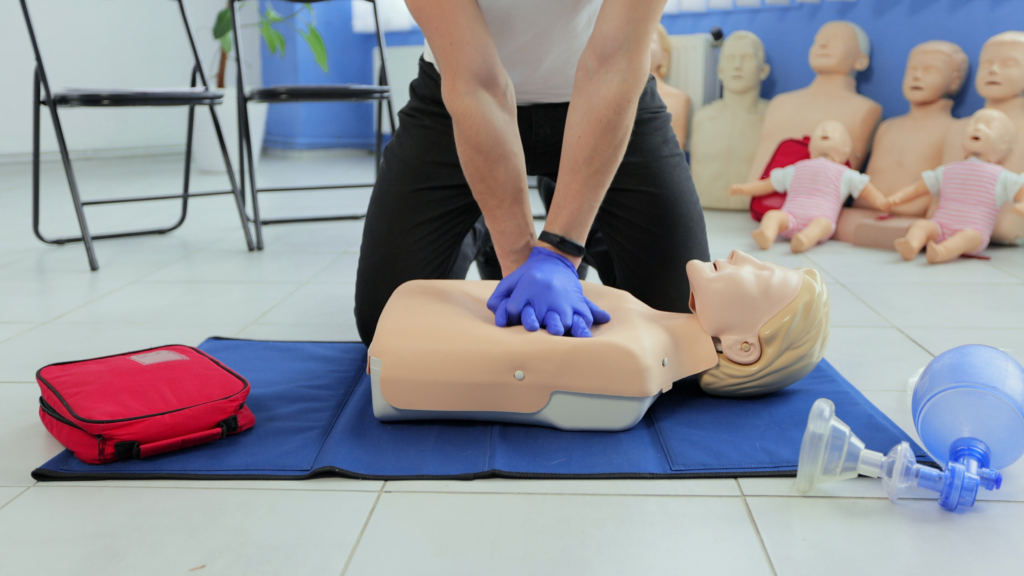
In UK healthcare, life support isn’t a “nice to have” skill — it’s part of safe practice. Whether you work on a ward, in ED, theatres, primary care, community services, dentistry, or outpatient clinics, you can be the first person to recognise deterioration, start resuscitation, or lead the first critical minutes until the arrest team arrives.
The good news: life support is highly trainable. Most of what separates a panicked response from a structured one is familiarity with a few core techniques — practised until they’re automatic.
We wrote an article that exposed the hidden cost of poor life support training and how medical professionals and organisations can avoid making those expensive mistakes. Read it here.
Below are 10 techniques every healthcare professional should know (and be able to do under pressure), aligned with Resuscitation Council UK (RCUK) guidance and the way emergencies unfold in real clinical settings.
If you are looking for an industry leading, RCUK-accredited Life Support training to level up your skills in 2026, check out our upcoming programmes, and secure an early space.
1) Rapid recognition and activation of help
The first “technique” is mental: spotting that something is seriously wrong and escalating immediately. RCUK guidance emphasises early recognition of cardiac arrest and getting help fast — including using emergency call handlers / responders to support the first steps.
What this looks like in practice:
- In hospital: put out the emergency call early (e.g., 2222 per local policy), bring the crash trolley/defib, and allocate someone to timekeeping and documentation.
- Out of hospital/community: call 999 (speakerphone if you’re alone) and start life-saving actions without delay.
A common real-world failure point is “watchful waiting” for just another set of obs. If your gut says “this isn’t right”, escalate and start a structured approach.
2) The ABCDE assessment
ABCDE (Airway, Breathing, Circulation, Disability, Exposure) turns chaos into a checklist. It helps you identify the thing that will kill the patient first — and fix it while the team mobilises.
RCUK paediatric guidance explicitly references ABCDE management, and the same structured approach underpins UK life support teaching across settings.
Practical tips:
- A: Can they speak? Look for obstruction, vomit, secretions. Open airway early.
- B: Work of breathing, chest rise, SpO₂, listen if appropriate. Give oxygen as indicated by local policy.
- C: Pulse, BP, cap refill, bleeding, ECG monitoring when available.
- D: AVPU/GCS, pupils, glucose (treat hypoglycaemia promptly if present).
- E: Temperature, rash, bleeding, obvious causes.
ABCDE is also what keeps you anchored when you’re leading: it gives you the “next right thing” to do.
3) High-quality chest compressions
If the patient is unresponsive and not breathing normally, start CPR. High-quality compressions are one of the most evidence-backed actions in resuscitation.
RCUK adult BLS guidance recommends:
- Rate: 100–120 per minute
- Depth: at least 5 cm but not more than 6 cm
- Minimise interruptions and allow full recoil
Micro-technique that matters:
- Shoulders over hands, straight arms, compress the centre of the chest.
- Switch compressors every ~2 minutes (fatigue sneaks up fast).
- Keep pauses short for rhythm checks/shocks.
If you only remember one physical skill: make it good compressions.
4) Safe and effective ventilations
Ventilation errors are common in real emergencies — and they’re very fixable with practice.
RCUK guidance highlights giving just enough air to make the chest rise and avoiding excessive ventilation.
Paediatric BLS guidance includes five initial breaths and notes competent providers should use bag-mask ventilation with oxygen.
What “good” looks like:
- Use head-tilt chin-lift (or jaw thrust if trauma is suspected).
- Create a seal (two-person BVM when possible).
- Ventilate slowly, watch for chest rise, avoid over-bagging.
This is one of the biggest differences between “I know the algorithm” and “I can do it when it counts”.
5) Airway opening manoeuvres and basic adjuncts
Before advanced airways arrive, airway basics save lives:
- Head tilt–chin lift (most patients)
- Jaw thrust (suspected cervical spine injury)
- Simple adjuncts (OPA/NPA if trained and within local scope)
- Suction when secretions/vomit obstruct the airway
In ALS teaching, airway support and high concentration oxygen are core considerations alongside good compressions.
If you’ve ever struggled to ventilate a patient, you already know: airway positioning is everything.
6) Early defibrillation and confident AED use
Defibrillation is time-critical in shockable rhythms — and AEDs are designed to be used quickly and safely.
RCUK adult BLS guidance supports early AED use as part of the response, with rapid transition from recognition → CPR → defib when available.
Practical technique points:
- Apply pads fast; follow prompts.
- Keep compressions going while pads are prepared (pause only when analysing/shocking).
- Make “stand clear” loud and unmissable.
The best teams treat the AED like a routine tool, not a sacred object you’re afraid to touch.
7) Choking management (adult) — fast, physical, and algorithmic
Choking is one of those emergencies that escalates frighteningly quickly. RCUK’s adult choking algorithm is deliberately simple:
- Encourage cough if mild/effective
- If severe/ineffective cough: 5 back blows, then 5 abdominal thrusts
- If the person becomes unresponsive: start CPR and ensure help is coming
Key safety detail: don’t do blind finger sweeps.
This is exactly the kind of skill that benefits from hands-on practice — because in real life, adrenaline makes people hesitate.
8) Paediatric life support differences
Even if you don’t work in paeds, you might be the closest clinician when a child collapses in a waiting room or community setting.
RCUK paediatric BLS includes:
- Five initial rescue breaths
- Compression:ventilation ratio of 15:2 for trained paediatric providers (or 30:2 if not)
Also remember:
- Causes are often respiratory (airway/breathing first matters).
- Compression depth is approximately one-third of the chest diameter (child/infant guidance varies by local training).
If paediatrics makes you nervous, that’s normal — and it’s also why structured paediatric courses exist.
9) Team-based resuscitation skills: roles, leadership, and closed-loop communication
Life support isn’t just clinical — it’s also coordination. Many arrests don’t fail because nobody knows CPR; they fail because nobody is directing the room.
Team techniques to practise:
- Clear role allocation: compressor, airway, defib, drugs, scribe, runner
- Closed-loop communication (“Give 1 mg adrenaline now” → “1 mg adrenaline given”)
- Structured rhythm checks and timekeeping
- Speaking up early about reversible causes and next steps
This is where scenario training shines: you can’t learn team dynamics from reading a poster.
10) Post-ROSC essentials and handover
Return of spontaneous circulation (ROSC) is a milestone, not the finish line. The immediate priorities are stabilisation and preventing rearrest:
- Airway protection and controlled ventilation
- Avoid extremes of oxygenation/ventilation (follow local protocol)
- Blood pressure support and ECG assessment
- Glucose, temperature, and ongoing monitoring
- Clear handover using SBAR and a timeline of events/interventions
This “after” phase is often where confidence drops — which is why it’s included in quality life support training, not treated as an afterthought.
Turning knowledge into performance
Most clinicians can describe these techniques. The gap is doing them smoothly under stress, with interruptions, noise, and competing demands.
That’s exactly why RCUK-accredited courses focus on structured algorithms, repetition, feedback, and realistic scenarios — so your hands and your brain know what to do before panic has a chance to kick in.
Pacemaker Academy delivers RCUK-accredited Life Support training across pathways including ILS, eILS, PILS and EPALS.
If you want to feel genuinely “ready” (not just “certified”), the most reliable route is hands-on training with coaching, team scenarios, and real-time correction — the stuff you can’t get from a quick online read.
Review your role requirements for ILS/PILS/EPALS, then book the course that matches your clinical setting and exposure.